Showing posts with label Order. Show all posts

Saturday, April 9, 2022

Organizing the Fabrics and Yarns

 Well, I did it! I took advantage of the cancelled activities brought on by a sick child, and I catalogued all my fabrics.  All of them.  Every. Single. One. (Except for the scraps, which live in a beautiful wooden cylindrical box.) 

I created folders based on fabric type: woven cotton and linen, velvet and silks, utility and upholstery, vintage linens, etc. I even have a folder for "Things to Cut Apart," like the two velvet 1940s bridesmaids dresses that are unwearable as-is, but have a lot of useful fabric that could be transformed into something else.....

Then I placed the scraps that are good sizes for quilts or other patchworky projects in gallon-sized ziploc bags according to colors: warm, cool, white. 

I even created a folder for the collars I have inherited.  Yes. I inherited collars


Then, because I was on total fire, I went on and catalogued all the yarns in those bins there, also by material, with notes on how many skeins and weight, etc.  

Now every fabric and yarn I own is in my phone in its proper folder, with a photo and note on the yardage.  They're all nestled back into the cedar chest in groups so that I know where the jerseys are, know where the many yards of white denim are (I use this for small slipcovering projects!), know where the velvets are.....and so on. 

This is probably the best organizational project I've done in years! I'm so satisfied with it. Now off to make Annie's Easter skirt.....

Saturday, March 5, 2022

Two Hours to Tidy

 Today I had two hours--one before picking Annie up from ballet and one after sitting with Finn and plotting out classes for next year--to work on our garage, which had turned from Reasonably Tidy Storage Space to Complete Pit of Utter Despair. 

I didn't think I'd get it done!  But by the time I closed the garage door last evening, order was restored (okay, except for Mr. P's workbench, but we'll get to that!).  

Call me an oddity, but I find that there are few things I enjoy more than taking a mess and putting it all to rights.  I just love the entire process: arranging, tossing, organizing, purging, sweeping, tidying.  It's so satisfying!  And yesterday I had done our fridge, which sorely needed it after weeks of neglect due to my running back and forth to Charleston.  It took about two hours there, too--and then I made pumpkin muffins, banana bread, rosemary-chipotle spiced nuts, spinach squares (yummier than they sound, I promise) and almond butter brownies (ditto) from all the bits and pieces I found that needed to be used. 

In fact, I think washing all those dishes took longer than it took to clean the garage!  But it was all good work, and now once the basement is tidied up, I'll feel like I've gotten my home back into shape!

And one more thing that I've discovered: Annie keeps her room immaculately tidy if she is permitted to go into it with an audiobook and listen to stories while she works.  She can spend hours on this.  Her room has gone from total disaster (last year) to being neat as a pin (this year) and the difference is Beverly Cleary!

Sunday, February 28, 2021

Organizing in 2021: The Refrigerator

 This year I'm going to post about organizing once a month.  Last month I talked about the most essential, for me, item: my planner!  This month: the fridge.

Here's the deal: most normal people probably don't worry about organizing their fridge, or they don't care, or they don't get bothered when it's crammed full or you have to hunt for something.  I readily admit that I may not be normal on this point.  But it does irritate me to open the refrigerator and find that I have no idea where the item I need is!  It's inefficient for me to spend a minute looking for something every time I open our refrigerator.  I mean, really.  Do you know how often I open that thing?  I should keep track.  

A lot.

Anyhow, I had indicated to my family what goes where, but that's hard to keep in one's head, particularly if one is a child. 

So a few years ago, I labeled my refrigerator shelves.  Ahhh!  

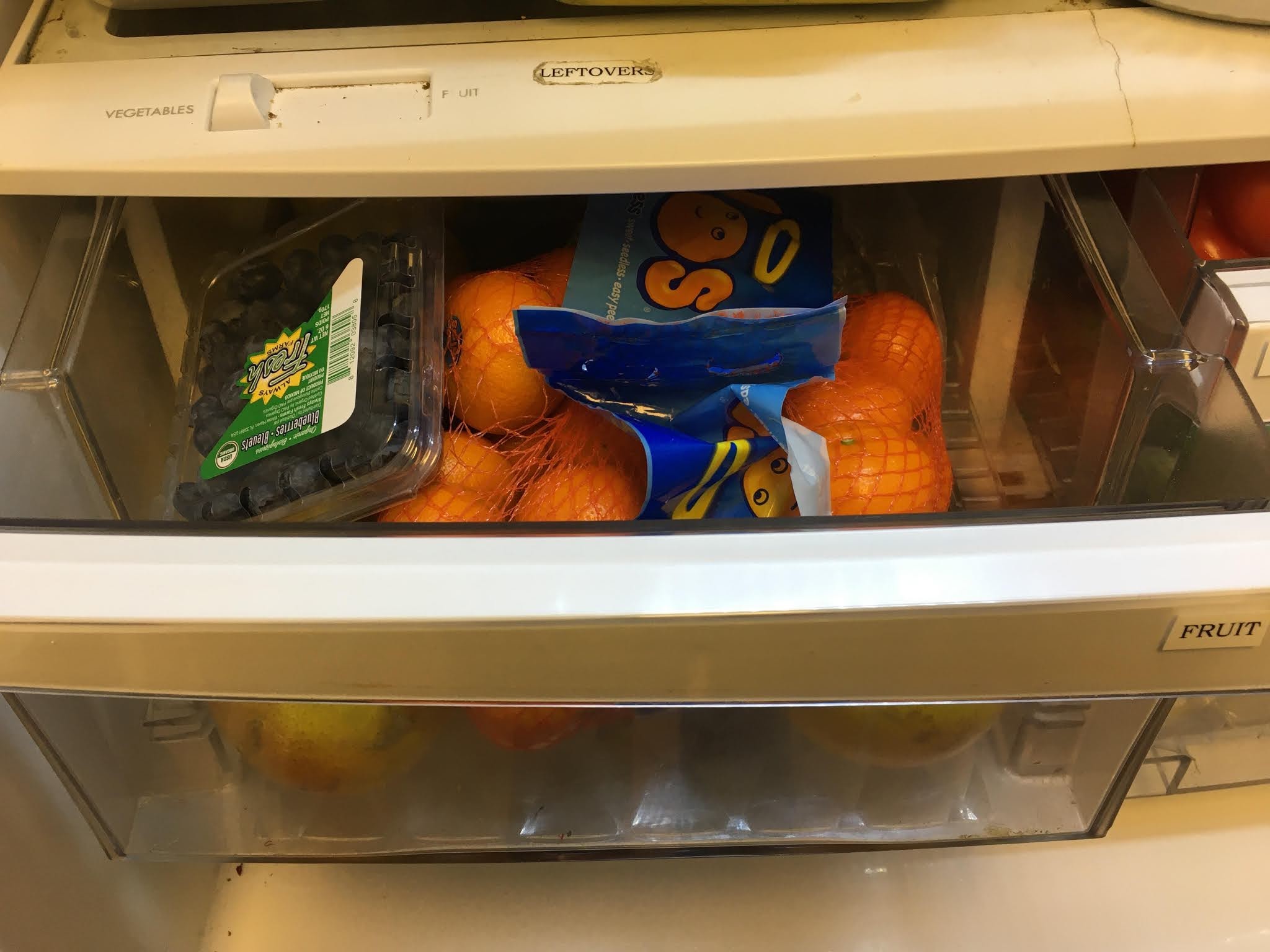
The day I took these photos was a day in which I'd done a large shopping trip.  My refrigerator is almost never this full. 


I printed labels and stuck them to shelves.  Game changer. Sometimes the fridge is like it was in these photos: packed, and I have to make allowances for putting something somewhere else. But in general, we know where to place things and where to find them. Since my family cannot read my mind, labels are helpful. 

Top right shelf: nuts/seeds.  I like to store these in glass jars, but I've gotten away from it.  We always have a lot of nuts on hand: pecans, almonds, sliced almonds, pine nuts, cashews, peanuts.  


On the top left-hand side there are salsas, relishes, jams, pickles. 


The middle shelf is for proteins--tofu, meats, yogurt, eggs.  (And, on this crowded day, cauliflower and strawberries. Ha!)


The bottom left hand area is for leftovers.  I don't like it when I completely forget that something exists in my fridge, so I check the leftover area for lunch ideas, little dinner add-ons, snacks, etc., which cuts down on food waste. 


On the bottom right shelf--veggies.  We have too many veggies, usually, and they take over most of the bottom shelf.  But this is where I put boxes of spinach and spring mix (I buy a large box of both every week) and any other veggies that will onto the shelf. In the drawer below I keep other veggies--always carrots, onions, plus cilantro, peppers, zucchini, etc.  


The bottom left drawer is for fruits. 


I have a wide drawer at the bottom which I just LOVE.  That's where I keep the cheeses, extra butters, and any other "overflow" proteins (on this day--pepperoni for homemade pizzas and tofu....). 


Top left bin of the door holds the butters. 


{not sure what's up with the sad little section of real butter there, but this is real life! I didn't scrub the fridge and make it pretty for these photos!}

On the top right part of the door I keep my jars of yeast as well as my little container of essential oils. 


On the next shelf I keep things we consider condiments: sauces, dressings, tahini (technically a seed butter, but it works here!), red curry paste, ketchup, mustards, etc. 


And the bottom shelf holds the milks!


The old adage "a place for everything and everything in its place" really works well for me with the refrigerator.  I value efficiency in the kitchen, because I make pretty much every meal we eat from scratch. Cooking is quite time-consuming for me, and I don't want to spend extra time hunting down things in the refrigerator.  My family knows where things go, and they are good about putting stuff back into place (generally). If I open the fridge and see something out of place, I just shuffle it back to its rightful spot, but because we've used these labels for years, that doesn't happen too often.  I'm not a taskmaster about it.  The whole point of organization is to make life easier--not to drive my family crazy. ;) 

So that's it!  An organized refrigerator is a joy to the family chef.  Truly!

Friday, January 29, 2021

Organizing in 2021: The Planner

This is the first in a series of little posts about organizing I'm going to do in 2021.  I meant to post this earlier in January, actually, but life intervened for a couple of weeks.  And that's alright. 

 Ever since I was 14 years old, I have used some kind of planner system.  I cannot imagine living without one.  There is no way I could do what I do now without a planner.  The orthodontist appointments, dental appointments, haircuts, ballet lessons, music lessons, meals, and homeschooling would be a wreck if I didn't use a planner, because--very honestly--my memory just isn't that great. 

There's a lot to running a household, too.  There are chores to do.  There are random things to remember (returning that jacket; ordering new pants for a quickly-growing child; dropping library books off to avoid late fees; sending a condolence card...).  My brain just isn't good enough to do all of this on its own. 

For years I used Mead Academic weekly planners.  They were my bread-and-butter throughout high school, college, graduate school, and law school. 

I used different things in different years in my adult life, and went through a fairly long Moleskine planner period not long ago. I loved those planners!

More recently, inspired by Anna, I began using an A5 Filofax.  I've used the Filofax for a few years now and it works very well for me. I don't particularly like the Filofax planner sheets (plus, they're pricey!) so I purchased some custom sheets on Etsy a couple years back.  Unfortunately, this seller hasn't created 2021 calendar pages.  But I still use the other items: the weekly planner and meal planner are my top two, and I use them every week.


I appreciate that I can tuck things into the front cover of the Filofax.  I keep my beloved Sharpie pen there.  In the little slits, I keep the name of the metal to which I'm allergic (gadolinium, if anyone cares!) and little cards containing my godchildren's baptism dates.  A reminder to pray for them.

Inside the front cover are random items I may need to reference: in this case, I think there's a prescription sheet for a new prescription the doctors gave my husband, plus some cash. I try to remember to keep a little cash on hand, so I don't have to go borrowing from the Bank of Finn. Ha!


The front of my Filofax has a sticker from the lovely and talented Paper Cactus Designs on it. (Leah is the daughter of my "blog friend" Roan.  I just love the stickers she creates!) 

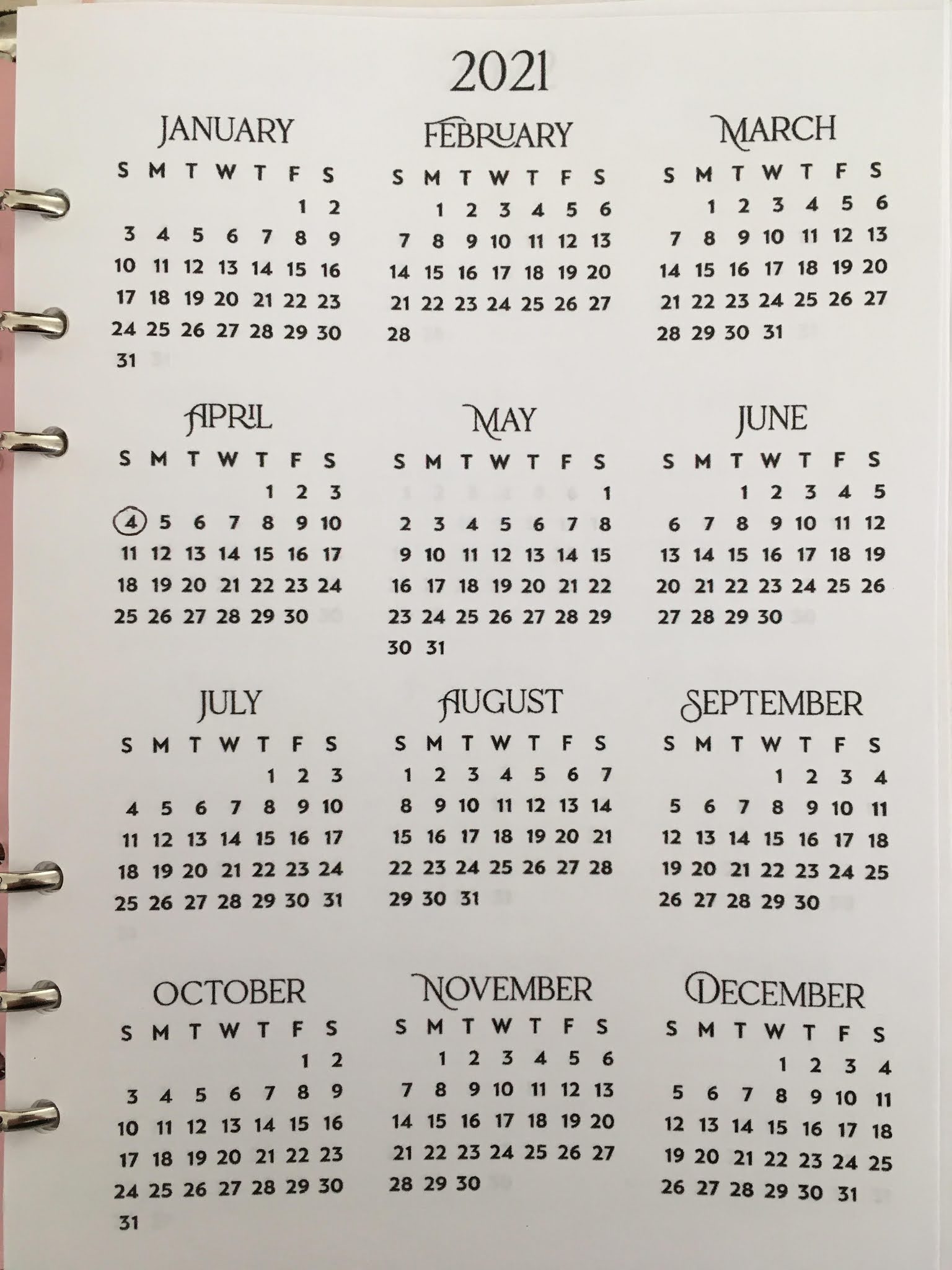
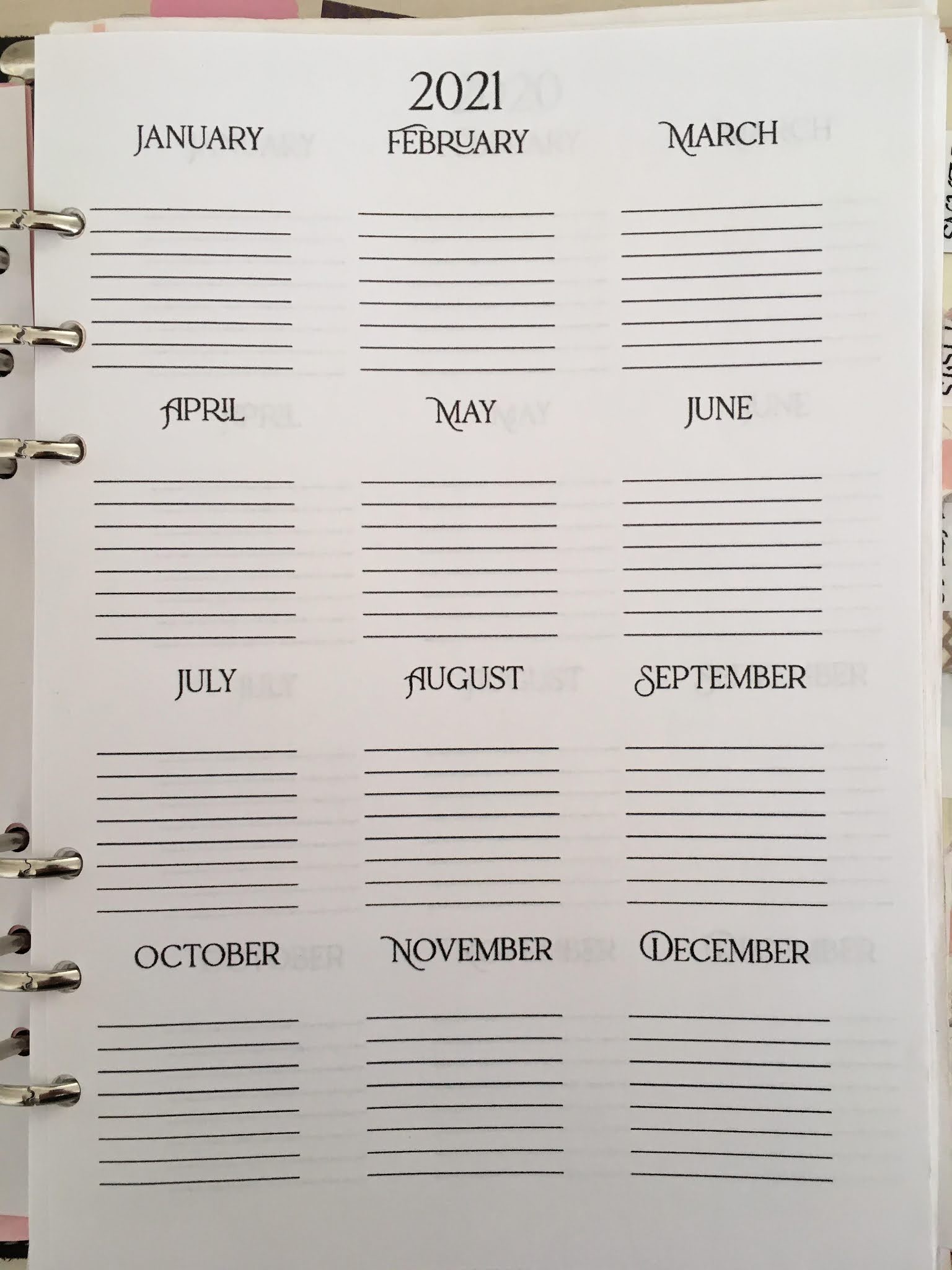
Just behind this I have a couple of pages of yearly layouts. 


When I took these photos, I hadn't yet filled in anything for the months yet, but I do plan to jot down a few reminders and goals for each month. Nothing major!


The first section contains monthly calendar pages--that's where I see the layout of the whole month. (I took a photo of a month where I hadn't written anything yet!  Except my note that we might go to Asheville in July. ;))


After this are the sections! I have six sections in my planner. 


The first section is called "plans." I set this up to accommodate my left-handed life.  I use the Filofax ruler as my page marker.  On the right side, I have my weekly planning page, where I plot out the week. On the back of my weekly planning page, I write out the week's workouts. 


 On the left, I have blank papers. I use the left-hand side for taking notes (daily to-do lists, people to call, etc--the messy stuff) while the weekly planner on the right guides and structures the week. I like my blank papers to be pink, of course!


 On the page after the weekly planner, I have my weekly meal planner (more on that later).  Beyond that, I have my printed daily routine, our chore chart (pictured only to show my kids' chores), and my weekly routine (not pictured).  And finally, I have several pages of typed exercises that I use when I plan my workouts.  


The next tab section is "Lists."  I am a list-maker.  I have a list for nearly everything!  This is where those lists live.  I have a list of places I'd like to visit locally.  Of places I'd like to travel "one day." A list of books I'd like to read, or would like for my children to read. I keep a list of items to take when we go camping (so we're not marooned outside without, say, umbrellas or extra batteries at 3am). I have a list of thing to write about on this blog, a list of YouTube videos I might one day make (if I ever decide to do that; I have so many ideas, but technology and I are not friendly with each other, and I'm shy! But I was inspired by seeing a page that features a man whose father died young, and he creates videos for young men to teach them the stuff they need to know--how great is that? As someone whose mother died young, I completely understand his motivation).  I have lists of items to sew.  I have a list of passwords (cryptic enough so no thief could possibly understand them).  I have a list of poem ideas.  I have a page for ideas and thoughts on a book I might one day write.  I have a home project list--all those pesky to-dos that pop up and need to be written down and addressed.  There's also a list of items we need for our lives or home, such as snow boots for one child (and the size needed), what size bedside lamps I'd like to get, etc. For me, a list is a therapeutic brain-emptying activity that helps me stay organized.  

The next section is "meals."  I keep my meal planning pages in this section, and just pull one out each week for jotting down what we'll have.  I also have a list of healthy meals and snacks here for myself--so that I have no excuses. :)  In addition, I have started to keep a list of things my husband cannot eat now that he has had oral cancer surgery.  Salmon fillets? No way, Jose. Sometimes I struggle to remember what is and isn't easy for him to eat, so this list helps me out.

I keep an actual grocery list on a magnetic pad on the side of my fridge. The second I detect that we are running low on something or need it from the store, I write it on that pad of paper!  It's a lifesaver, I tell you!

The next section is "money."  The first page is our annual budget, which I like to make in January each year.  I try to keep track of our spending in major categories, so on the pages following the budget, I have one page per month, and that's where I will keep track of expenses to see how we are faring.  We are not particularly diligent at keeping track of a budget (my husband thinks it's a waste of time, but he is THE most frugal person!), but I appreciate having a basic idea of how much I should spend on groceries, clothing, etc.  Our goal is not to live within our means; our goal is to live below our means. Having a rough estimate of where we are financially is helpful to me.  But I will say that I haven't made a budget for 2021 yet, and I haven't tracked the first expense yet.  I may pick that up in February or March. 

The next tab is labeled "health." In this section I have my notes from my Louise Parker Method learning, and any other health tidbits that I feel are helpful to me.  

The last section is "seasonal."  Here's where I have planning pages for Christmas.  A comprehensive list of what we'd like to do during the season, plus all the gift lists and checklists I need for helping the holiday run smoothly. 


  The back cover contains a few sentimental things (a poem, a letter from an acquaintance, a photo), that I like to keep as reminders of the good things in my life. 

*           *           *

The point of all of this is just this: I think organization starts with planning.  It doesn't have to be complex and it surely doesn't need to be a Filofax.  I think what most people need is quite basic:

a calendar

some sort of weekly or daily plan--can be as informal or as formal as you like!

a meal plan

pages for lists you want to keep/make

That's really it.  Everything else just depends on your unique life circumstances.  But having a place for the calendar, the meal ideas, the plan, and the lists, is extremely helpful. I like to have them all in one place, but some people may prefer to use a digital device for some of these lists, or a paper on the fridge for the menu plan.  Whatever!  The nuts and bolts don't matter as much as just having something that will serve you well.  You want to be able to remember appointments, have a good idea of what to eat during the week, and have a general outline of what must be done during the week. That's it!

As far as which planner to use, I must say, there are some very expensive ones out there.  The Filofax isn't cheap (I bought mine on Amazon for a good price a few years back), but since I don't have to purchase a new planner every year--I just print pages--I feel it was a good investment.  But I must say, for years I made great plans with planners I purchased for $10 or less.  Places like TJ Maxx/Home Goods sometimes have great planners that are quite pretty for really good prices!  Frankly, even a 20-cent composition notebook from the grocery store will work if you're willing to draw a little calendar for each month. Don't let price be a sticking point. 

If you have any planning tips or tricks, let me know. I love learning how other people structure their days! 

Saturday, January 16, 2021

Organizing in 2021

 I have many flaws, but one strength I have is that I am a pretty well-organized person.  This trait has helped tremendously over the years as I had to learn to manage a household, raise children, and homeschool, all from scratch.  I had zero domestic training as a teenager and young adult.  I was trained to read, think, write, and practice law.  I was not trained to run a household. (I won't be making that mistake with either of my own children!)

The learning curve was steep, but eventually I got pretty good at these domestic things, and I think that one of my innate strengths--organization--really helped.

There are times in life when I'm not as "together."  During most of 2018 I used my executive functioning skills on the practical aspects of being caregiver to a cancer patient and meeting my children's emotional needs.  It was time well-spent; it was worth every minute.  My closets may not have been as tidy as I'd like, but I was doing what was most important in life, and I have zero regrets about that.  

So this year I plan to do one organizing post per month, because--let's face it--most people don't have time to organize constantly.  But perhaps one tip per month will help someone out there who, like me, is perhaps struggling to learn how to run a household smoothly, efficiently, and (most importantly), with love. 

Here's the lineup:

January: The Planner

February: The Fridge  

March: The Pantry 

April: The Leaving-the-House Items 

May: The Seasonal Stuff 

June: The Meals 

July: The School Books and Bins 

August: The Important Documents 

September: The Car 

October: The Library 

November: The Holidays 

December: The Chores 

I am not sure that I have anything too earth-shattering to share (you may have great ideas, too, and if so, I welcome them! I love learning new tips and tricks), but perhaps these posts will help someone!

Friday, October 9, 2020

Restlessness, the Hard Master

"Restlessness, from being a good servant, might become a hard master; indeed, he does sometimes become so, and people do things that are too hard for them in the way of rowing or climbing, running or jumping.  Worse still, the Daemon of Restlessness possesses them, and they cannot settle to any kind of work or play because they always want to be doing something else.  This is a very unfortunate state to get into, because it is only by going on doing one thing steadily that we learn to do it well, whether it be cricket or algebra...." 

Charlotte Mason, Ourselves 

I am currently enjoying a Living Education Lesson season with Nancy Kelly, and in it, we are reading part of Ourselves.  If you aren't familiar with this volume of her six-volume series, it's a wonderful book on character development. Mason originally wrote it for teenagers, but its instructive truths are perfectly enlightening for adults--and include good reminders that we all need. I know I am not the only person who has read it as an adult and wished that I'd read it 30 years earlier!  

This passage stood out to me recently because I was thinking of how utterly distracted we can all be.  Between cell phones, YouTube, constant sources of news, push notifications, social media apps....how in the world, I often wonder, does anyone without limitations on technology settle down to do anything at all? It seems so omnipresent.  

Mason was writing this long before smartphones hijacked our minds.  Restlessness isn't a new problem; it's just that we now have new ways of indulging in it.  You can never achieve mastery of foreign language, math, or music without a steady daily effort; I think we can all agree to that.  But how about in our domestic lives?

I can see how restlessness has resulted in half-finished chores and projects in my own life in the past!  As I've aged, I've gotten much better at "settling down" and sticking with a task or project, and seeing it through to the end.  There's probably a personality type that struggles with this more than others (probably the creative type!).  If you're like me, you get excited over possibilities.  And then you can get extremely bogged down in implementation,  By disciplining myself to implement--slowly, surely--I accomplish much more than I ever did when I was trying to do ten creative things all at once. 

Restlessness can even disturb our most mundane tasks.  Sometimes it takes actual discipline to finish cleaning the kitchen (all the way), to fold and put away all the laundry, to get the bathroom totally cleaned. Of course, sometimes we have to just do the best we can and leave the rest--like when you have small children! Or if you are ill, or have a spouse or close loved one with an illness. 

Self-discipline is one of the best skills I think we can learn ourselves and teach our children. It's one reason I value chores, music lessons, and Annie's ballet class for my children. They teach us to do things in a systematic, orderly, continuous way, and they train us to do them even when we don't want to do them!  I actually believe that self-discipline soothes the savage beast of restlessness.  But no amount of chores, piano practices, or plies will teach my children to focus if I am not willing to focus myself!  So I also try hard to practice disciplines in my own life: daily exercise, my own chores and housework, and completion of tasks and projects I begin.  This may be one of those things that is "caught" more than taught, but it's important, particularly in our age of countless distractions.  (And addictions: did you know social media was designed to be addictive?) 

"...it is only by going on doing one thing steadily that we learn to do it well..."

Thanks to Charlotte Mason, once again, for the truth and inspiration!


Saturday, August 8, 2020

Advice for New Homeschoolers: Practical Tips

I recently tried to give a little homeschooling advice for anyone who is entering this stage of life for the first time.  Most of the advice was more theory, or how we think about homeschooling.  But sometimes a few practical tips help, too.  So this is my Practical Homeschooling post: a few things that I've learned over the past 8 (!!) years of homeschooling. 

1.  Know what's for dinner.  Having a menu plan is so helpful.  Just have a good idea of what's for dinner, and on busy days, don't hesitate to put dinner in the crockpot.  It's wonderful to do the work first thing in the morning!  I particularly like to do this when we have activities later in the afternoon.  Freezer meals are also helpful. For health and financial reasons, we prefer to eat at home, so I try to be on top of dinner--out of necessity!

2.  Get your rest.  Don't stay up late. :) Most of us are nicer when we've had our rest. (Even Charlotte Mason herself said this: "Do not sit up late preparing lessons; what you seem to gain in preparation you lose by tiredness next day." YES!) 

3.  If possible, once the day begins, put your phone on airplane mode (or turn it off) and don't use it until the schooling is done.

4.  Create a brief chore list for yourself of morning chores, midday chores, and evening chores, and stick with it as much as you can. Keep the lists simple and not too onerous.  Meals, laundry, pet care, and kitchen/bathroom hygiene are the true essentials, so have the chore lists focus on making sure these are covered.  

5.  Choose one place for your school items, and keep them there.  Every day after the academic stuff is done, put things back to rights.  This is a sanity-saver! (I also love using my labelmaker.)  Maybe I'll post a few schoolroom photos.  I really, really need order.  I can be kind and gentle even when things are chaotic, but it's much easier if things are orderly. :) 

6. Lower your homemaking expectations. The truth is, having children at home all day is kind of a messy, happy sort of chaos!  They play, they eat, they do crafts.  Gently train them to pick up after themselves (don't be harsh; it never wins their allegiance), but realize that the house may be messier, and you almost certainly won't get as much done.  It's okay.  This is a season of life.  Remember that babies (and toddlers, and preschoolers, and elementary schoolers, and middle schoolers.....) don't keep. Enjoy them while you have them!

7. Be kind and gentle to yourself, because that's how you can be kind and gentle to others. If you need to take a walk each day, or exercise, or work on a hobby, or whatever, try to carve out a tiny bit of time to do those things that make you feel more human, because your attitude and your spirit set the tone of the entire house.  Take care of yourself.  

I could say all sorts of things about juggling domestic tasks and homeschooling, but that might be overwhelming.  I think this simple list of tips is sufficient; it covers the bases of what I consider the most practical issues.  There are many, many things I could write about specific curricula, educational philosophies, interesting books to read on homeschooling, etc., but those are beyond the scope of this post.  This is more about the "boots on the ground" essential issues of day-to-day life when homeschooling: keeping routines, maintaining some semblance of order, feeding people, and taking care of yourself!

Wednesday, July 1, 2020

Living with a Schedule v. Winging It

{The photos have nothing to do with the post.  I just thought I'd share some random ones.  This is sudangrass starting to pop up earlier this spring.}

Ever since I was in high school I've had a planner of some sort that I have used every single year.  For my college years I remember that I always used a basic planner with a two-page weekly spread and a nice monthly calendar. These planners were spiral-bound, cost about $10 or less at Staples or Office Max, and were *essential* to my existence!

I've tried many, many ways of scheduling and organizing my days over the years. When my babies were babies, it was more about keeping a planner so that I would know when I had appointments to keep, and a running to-do list, but the days themselves were quite loose.

During our busy academic seasons of the past few years, the planner has been essential for me to keep my head on straight while managing all of my children's activities, my own domestic tasks, my husband's schedule, etc. 

When my husband had cancer, I didn't use a planner for six months.  I had a planner, but I'm sure it was only used for doctor's appointments. I recall being ambivalent about lists.  I sort of floated through our days, taking care of whatever was in front of me, and not worrying about anything else.  It was all I could do, and it was enough.

I currently use a Filofax, with a very specific printable planning kit I bought via Etsy, and I LOVE it!  

However, during quarantine, our external structure disintegrated because all of our activities were cancelled (or moved online, in a few cases).  I quickly realized that without the rhythms of my normal activities, my day could quickly descend into chaos, and I could quickly descend into irritation!  Each day has different needs, and I do not like for all my days to be exactly the same, so I can't have the same schedule every day.  But I need some kind of structure.

{A great breakfast: bowl of berries, avocado toast with garlic and tomatoes, and coffee!}

So I came up with a solution--one that sounded crazy to me at first, but has worked beautifully: at night, I type up and print out a schedule for the next day!

From the time I wake up to the time I go to sleep, the time is planned.  Of course I naturally veer off at different points every day.  But this loose, flexible, needs-based approach has helped me tremendously.  I don't plan more than one day ahead (which is hard for me, but essential, because every day IS different in my life, and new needs pop up frequently).  My children are older, so they are predictable, and that helps.  I keep a running list of what needs to be done, and each night I check the list and see if I can squeeze any of those things into the next day.  I also include time to play with my children! 

(I realize that some people are so fun that they do not need to schedule fun.  

I have realized--and this is painful to admit--that I am not that fun.  So I am intentional about carving out time for fun!)

I use a two-column table in Microsoft Word. In the left column I put the block of time and in the right column I put the tasks or activities I want to do during that segment of time.  

{Evidence of my hosta fanaticism. I love hostas. They're actually in bloom right now!}

For some reason, this past Sunday night I didn't make a schedule for Monday.  And Tuesday we were going to be away from the house all day with necessary dental appointments and errands.  And since I didn't make a Monday or Tuesday schedule, and because last night was a late one due to all of us doing something as a family that ran waaaay late, I figured I'd let Wednesday be a "wing it" day, too.

Well.  As of about 11:00 this morning I realized that I had made a big mistake.  I was still in my pajamas.  The kitchen hadn't been cleaned from breakfast.  Finn was in his pajamas, asking me Important Theological Questions.  And I was trying to answer them and stay focused while in my pajamas with my back turned to my very dirty kitchen.  

Now, I'll gladly rearrange the entire morning's schedule if my child wants to talk to me about theology or the Bible or any other Major Issue in life, but I'd really rather that happen while I'm at least dressed and not trying to ignore a messy kitchen!  So here's the moral of that story: I'm not someone who can Wing It (my husband is), though I admire people who can. I just can't. It ends up devolving into me wandering around the house in my pajamas, forgetting laundry in the washer, and trying to figure out what to do next, so I need my plan on paper. 

{My violin.  I hope to add this to my daily schedule again very soon.}

When I printed the plan tonight, I felt so much better.  

Lord willing, I'll be in real clothes at 11:00 tomorrow, with a clean kitchen, and a list of chores already done! Whew!

Thursday, June 11, 2020

Organizing the Garage

I am blessed by being married to a genius.  It's a running joke in our household, really: how smart my husband is.  He's a mechanical engineer, and those guys are handy to have around!  They're so capable.

My husband has few areas of weakness, but he'd admit that one of them is organization. Part of that is his brilliance: his mind is so good he remember details from decades ago. He has never, not once, used a planner, list, organizer, or calendar.  He doesn't see the point...whereas I depend on my plans and lists and calendar to keep me on track!  We are two very different humans in that regard.

Organizing is fun for me, but the garage has always eluded me because much of it belongs to my husband.  So many tools, mysterious gadgets and gizmos, random items.  I have tidily organized all the seasonal decorations, the gardening supplies, the canning equipment, the camping supplies, the recreational equipment...but I never have organized *his* stuff in the garage because I don't know what it is! It's all so elusive!

Over the Memorial Day holiday weekend, I decided that before we do any summertime projects, I would organize once and for all. My husband was off for four days. For three days (because I didn't work on the project on Sunday), he was on call to answer my questions. I learned SO MUCH!  I can now distinguish hex bolts from sheet metal bolts, hose clamps from speed clamps, punching tools from drivers, jigsaw blades from files.  I learned more about tools in the past week than I had in the past 42 years of my life.


(I can't find my "before" picture, but there was basically nothing hanging on the pegboard, and there was a 2'-tall pile of random everythings on top of the workbench. Seriously!)

And I organized every last bit of it! Every scrap!  I sorted, tossed, grouped, labeled.  It was so satisfying.


Now, at long last, my husband knows where everything is (he once famously had to go buy a tape measure because he couldn't find his tape measure!). And my children have already spent an entire afternoon at the workbenches, building medieval tools from duct tape and PVC pipe, while I worked in the flower beds.  "The garage is so great!" they enthused.  And when they were done, it was quick and easy for us to tidy up because the garage finally follows my rule: a place for everything and everything in its place.


Sigh. So much better!


(We also got rid of all the random paints we no longer needed!)

So now I've moved on to painting the dining room furniture (while listening to Middlemarch on Audible). It feels so good to work on projects in an organized, tidy space.  At last!!

Wednesday, August 21, 2019

Charlotte Mason Minimalism: Reconciling the 13th Principle with Real Life (Part 1, Philosophy)

Over the years I have jokingly referred to myself as a "Mason Minimalist" when describing my homeschooling style.  I admire and follow Charlotte Mason's 20 Principles, and employ many of her methods, but....

I'm kind of a minimalist.

I didn't start out that way; when Finn was in kindergarten I created an elaborate filing system for all his "subjects" (what was I thinking?!).  This system barely lasted a few weeks, if I recall correctly, in part because my sweet tornado Annie was a toddler.  

Over the years I've had to hone in, revamp, make lists, toss the lists out, re-prioritize, re-think, etc.  In the few months before my husband was diagnosed with cancer, I was, for the first time, following a Charlotte Mason curriculum fairly closely, using lesson plans (!)(that's so not me!).  It is a beautiful curriculum full of  good things, but along about late October of that school year I was just exhausted.  I simplified a little and continued on until our Christmas break, and on December 18th my husband got his diagnosis. Needless to say, the curriculum went out the window.

I was forced to re-think things.  I re-read Mason's principles--many times.  I thought about how to stay faithful to those principles even in the midst of illness or crisis.  I prayed. I journaled. I adapted.  My husband had surgery in January 2018 and returned to work after a month at home, and we finished out that school year with a fairly minimalist homeschooling routine, and I was looking forward to an easy summer of pool time and thinking when his cancer recurred--with a vengeance.  From May to December last year, we were dealing with surgery, radiation, chemo, living in another state for a couple of months, side effects, doctor's appointments, et cetera. I was an absolute minimalist during that time; in fact, when we lived in North Carolina, I did a bit of school here or there when I could (highly simplified), left my children to their own devices as much as possible, and felt gratitude to my best friend Allison for reading to the children, taking them to the library, and doing interesting things with them when all I could do was call the insurance company or try to help my husband manage his symptoms.

2018 was the year of cancer, but it was also the year that cemented in my mind the idea that minimalism is okay.

*                 *              *

When Charlotte Mason homeschoolers get together we throw around the word "feast" a lot.  It's a beautiful feast, this type of education: everything from history via living books to brush drawing, from hymns to modern languages, from picture study to natural history.  Any curriculum that tries to stay true to Mason's methods will invariably include all of these things, and many more, in a well-organized way.

But of course that must be balanced with reality.  We have to figure what is sustainable for our personalities and family situations.


{a simple supper a few nights ago, with zinnias from our neighbor}

The 13th Principle states that in devising a syllabus/course of study for a child, 3 points should be considered:

first, the child requires much knowledge; that is, sufficient "food" for the mind;
second, the knowledge should be full of variety to stimulate the mental appetite; and
third, the knowledge should be communicated in "well-chosen language" because we naturally gravitate to ideas conveyed in literary form.

The "feast" idea stems from the idea that a child needs a good variety of much knowledge.  It's the buffet.  Lots of choices.

In a school setting, this appears to look like short (often timed, so to be sure they are short) lessons on multiple subjects.  On paper it is beautiful and I have created perfectly beautiful "on paper" plans!  The issue is that in real life at home there are complications to the plans:

you need to attend a funeral (this is our reality this morning, actually) and help with the post-reception cleanup
the roofing company guy pulls up to measure your house for the new roof
the cat becomes sick to her stomach
your husband needs you to call the car dealership
your neighbor--sweetest person on earth-- needs to take her ill child for bloodwork and asks if you could watch two of  her other children while they are gone

Today is only Wednesday that's my *actual* week so far!


{real life: a geriatric dog and my husband's dresser in the living room because our bathroom is being tiled and we had to move the dresser out of the way....so it goes....}

I could set strict boundaries around our school time.  I could decline to attend the funeral of the dear family friend who looked after my mother so sweetly during a hard time in her life.  I could ignore the roofing guy (although the roof is such a huge investment that I don't think that would be wise). I could ignore the cat issue (yuck, I don't think I could do that).  I could decline to call the car dealership. I could decline to babysit. 

But I'm not sure that living a life that is quite that insulated from reality, or inflexible with real human needs, would be an appropriate education for my children.  I don't want them to think that our agenda is the most important one all the time.

It is healthy and good to keep boundaries in life.  During the day I almost never answer the phone unless it's my husband, a parent, or a doctor's office.  I try to schedule our appointments and outings in the afternoon, presumably after we have done most of our daily work.  And I try to keep to a strict rule, if at all possible: no more than one Extra Thing per day, so that we can have plenty of margin.


{from a recent field trip to a colonial-era home}

But the reality of our lives is that interruptions will happen.  And I agree with C.S. Lewis:

"The great thing, if one can, is to stop regarding all the unpleasant things as interruptions of one's 'own,' or 'real' life.  The truth is of course that what one calls the interruptions are precisely one's real life--the life God is sending one day by day."

So that's the philosophical perspective I take when pondering the issue of how to structure our "school days."  Next time I'll write about the practical side of it; how I actually structure things so that we can enjoy a 'feast' without a checklist or stress. 

Sunday, July 21, 2019

How Do You Have Time?


I get this question from time to time: how do you have time? It seems like when someone learns that I sew--even intermittently!, or spend time reading and/or writing each day, or exercising almost every day, or practicing violin, or {insert something else} I get asked how I have time to do it.

First of all, I always tell people not to be deceived: I don't do all of these things every single day. But I do at least a couple of them on most days. 

We all have the same amount of time in our day.  But we all have different priorities, family lives, needs, etc.  

I'm at a place in life now where I try to get up by 6am each day (today it was 6:07).  But there is no way that would have worked when I had little children.  My babies and toddlers were not easy sleepers, and I was often exhausted in the morning. I'd easily sleep until 8 am if they stayed asleep, and I needed the rest!  So it's not helpful to make blanket statements like "get up early."  Sometimes you just can't! (Getting up in the 5:00 hour does enable me to be more productive....I just don't recommend it because everyone's needs are so unique.)


But there are are a few things that I do that I think buy more time and can apply to people with different life situations.

*No television.  People hate to hear this and I don't say it unless I'm asked (except on my own blog, ha!), but I literally never, ever watch television.  I have gone through spurts of watching TV (especially in my 20s) but it has been years since I actually sat down and watched a show.  I am not even sure I know how to turn our TV on!  I don't care what's on TV and at night after our children are in bed I love curling up with a stack of books.  It calms me, encourages sleep, and feels like a connected, happy quiet. TV is too stimulating, distracting, and commercialized for me.  

I know people argue that television is a way to relax and escape.  This may be true.  But I think there are probably more rewarding ways to relax at the end of the day.


(like: my evening walk!)

*Strict boundaries on Internet use. I have had to develop this strictness over the years.  It's so easy to "check something" online and resurface hours later!  Social media in particular is addicting (it's designed to be).  I don't have a Facebook app on my phone and have ALL notifications on my phone turned off.  I try to keep a running list of "things to look up/do" on the internet, including email, buying stuff, and reading, and once I have a fairly solid list, I pull out the laptop and work my way down that list.  (This blog post was on that list!)  And I avoid watching any movies or YouTube videos unless I'm on the elliptical trainer. 

I have also turned off all text notifications on my phone, which I can do because I don't have children who are independent and driving around.  I try to check texts just a couple times a day. 

*Less stuff=more time.  I know we have all heard this before but it's TRUE!  The more items you own, the more time you have to take to clean it, organize it, store it, manage it, arrange it, dust it.  I have always enjoyed purging, but also seemed to easily acquire things, even just from generous neighbors or thrift stores.  But since my husband was diagnosed with cancer 19 months ago I got ruthless with the stuff we own.  I have gotten rid of some really good stuff, y'all!  A telescope, a dress form, furniture, lots of books, china, sheets, toys, clothes, my mother's vintage brandy glasses....you name it, I've purged it in some way or another.  I have come to see stuff as a burden that comes between me and the life I want to live with my family.  I hate it when I don't play a game of Candyland with my daughter or have a talk with my son because I feel like I need to tidy up the clutter or organize a space.  So I took the bull by the horns and am finally beginning to enjoy the fruits of my labor. 


I'm a minimalist now.  Of course, if you walk into my house you will see stuff (right now Annie has four puzzles all worked on a table in the living room!), because we live here and my children have creative work to do.  My house doesn't look like a photo of a minimalist's house, with one white sofa and four white walls and a potted plant.  Nope. That's not cozy enough for me--plus, I love books and artwork too much.  But I define minimalism as intentionally choosing what's important and disregarding the rest. We have pared down significantly, and the benefit is that it's so much easier to keep things neat and clean, even when they get sort of messy (see the puzzles on our living room table).  I don't have a lot of stuff to manage, so the stuff that is left is....easy to manage.  

And, honestly, I can still pare down.  And I still plan to pare down. In fact, I plan to do more purging this summer and fall, until we are truly left with the essentials (although I do consider 3 guitars, 2 violins, and 2 pianos essential...see? I'm not getting rid of everything!). 

 I'm using this minimalist lens in every area of my life. It has brought so much peace into my heart. 

*Prioritizing top needs of each day.  Trying to do everything every day just leads to distraction and feeling frenzied--at least in my experience.  I focus on accomplishing 3 things each day in addition to the stuff of daily life (like keeping house and caring for my family's educational, laundry, and nutritional needs).  I find that focusing like this somehow gives me MORE time. 


*Mastering the fine art of saying no. I am so good at saying no!  No to more stuff, no to obligations that I can't fulfill without feeling stressed, no to activities and involvements that take time away from what matters most to us.  I think it's hard for some women to say no because we want to please people.  But the more you get used to saying "unfortunately, I can't do that," the easier it is.  I am an oldest child, perfectionistic, classic people pleaser, so if I can learn to say no with confidence, I think anyone can.  

*             *            * 

I'm not suggesting that everyone adopt all of these things. I'm just offering them as the things that I do that I think allow me to have the margin in my life to do interesting things and also to enjoy my family more. 


If you have babies or toddlers, or a sick spouse or parent or child, life is just going to be different, but paring down and prioritizing helps so much in those situations.  In those cases, you need more time than other people do, but you also need more margin.  Be kind and gentle to yourself, and do whatever you need to do to simplify, even if it feels radical or counter-cultural.  

People above things, always! 

Thursday, May 30, 2019

Home Life Help: Four Efficiency Tips

Now that my husband is officially in remission (insert all the praises and hallelujahs and joy, which I continue to have all the time!!!!), we have slowly returned to a more "normal" life.  Once he returned to work in January, the children and I settled into a school and lessons/co-op routine that was more structured than the laissez-faire approach we had taken for part of the fall (but still not that structured--I like a lot of flexibility). 

With all of that, I realized needed to manage housekeeping with more efficiency. 

Now, before I get into my tips, let me say this: efficiency is not my goal in homemaking or life. I'm naturally fairly efficient and organized, but in my opinion the only reason to be efficient is in order to foster relationships.  I'll gladly do "inefficient" things when they feel right (for instance, I often handwash dishes because I like it, although it's not as efficient as using the dishwasher, and I love hanging out the laundry, and I don't try to squeeze every second out of my day--I had enough of that when I was practicing law).

Efficiency, taken to its extreme, becomes exploitative, as Wendell Berry points out. And care is often quite inefficient.

Still, certain systems do help me manage my life more efficiently, which then opens up my life to doing lovely, inefficient things like sipping tea on the deck while reading a book! 

So here are a few things that I have found helpful recently:

1) Laundry twice a week.  Since my first baby was born I always did a bit of laundry every day except Sunday (and I would wash laundry on Sunday when it needed washing!).  My babies wore cloth diapers most of the time, so that alone was a staggering amount of laundry. Add to that spit-up, two parents who exercise a lot, toddler accidents here and there, and plenty of playing outside (usually in dirt!), and we had a lot of laundry to wash! 

Now that my children are older and a lot tidier, I realized I was just running on a laundry hamster wheel by doing some every day. It never felt "done" and I nearly always had to remember to switch it out, fold something, put something away, etc.  I realized that in this season of life, that's a pretty inefficient way to manage our laundry.

So I changed my approach. On Mondays and Fridays we are usually home all day, so those are my designated laundry days.  I'll wash all the clothing, towels, and rags that need to be done, and then do 1-2 loads of sheets.  Sticking with it all day long and meeting the end goal of finishing it by bedtime is SO satisfying!  This week I left clean sheets in the dryer for a few days because I didn't have to fold them and put them away, so I didn't! But they were clean and dry, and that felt "done" enough for me.  I love this approach to laundry. It works great for us right now, and my family isn't coming to me and saying "are there any clean socks?" or "I'm out of tee-shirts!" 

2) ClickList shopping.  When I first heard of this I thought it was a nice service for the elderly, disabled, or for new moms.  I didn't even consider doing it for me because I'm an able-bodied human who can easily walk through a grocery store, and my children are no longer babies or toddlers.  But earlier this year I surveyed the week ahead and realized I needed that extra hour in my week.  I made the grocery list the night before and was pleased to see that I could clip coupons while doing the online shopping.  I wasn't sure I wanted a stranger picking out my produce or perishables, but I thought I'd give it a shot.  

I was pleasantly surprised by the entire experience!  It was super-efficient and my produce was perfect (they even got the avocados right which stunned me).  They didn't have one item that I had on my list and substituted it with a higher-priced item, but they only charge the lower price when they do that.  Also, my grocery bill was much lower than normal. I never thought of myself as an impulse shopper since I stick pretty faithfully to my list, but as it turns out, I think I do add things to the cart--often things I think we might need.  

 Once the farms are open for business, my grocery store trips slack off.  I do enjoy grocery shopping sometimes and like walking through the aisles, looking at things, and in our small community it's also a social hour :), so I like those things, but on weeks when we are pressed for time, I appreciate being able to use ClickList. 

3) Streamlining the children's chores. In our days before cancer, my children had a fairly extensive morning chore list.  I dropped that during treatments and recovery because I simply didn't have the mental wherewithal to manage chores, and they just did the most basic things (bed, teeth, hair, shower). I decided that we needed to get back to chores, but I realized that most of the things on their morning lists were things that did not need to be done daily.  Do I really need for my daughter to empty the bathroom trash cans every day? No.  Does my son really need to wipe down the bathroom sink every day?  No.  So their morning chores are bed-making, grooming, and pet care.  Then after school, they have *ONE* chore per day to do.  Each day is different.  This keeps it not overwhelming (one chore doesn't take long), helps them not feel bored with doing the same thing over and over again, and ensures that things get done on a solid routine.  I am so happy with this approach! I also have one or two afternoon chores per day, and we all take Sunday off. 

4) Kitchen helper.  Possibly the most genius idea that ever entered my brain, the "kitchen helper" has made my life infinitely easier.  I decided that my children are, at 11 and 8, quite old enough to be genuinely useful in the kitchen.  So each night I alternate having a kitchen helper.  The kitchen helper's job is to set the table, help with any sous chef tasks while I cook, clear the table, help wash and dry dishes, and do any odd kitchen jobs that need doing in the evening.  This has cut my time in the kitchen at night by half, I think!  Even Annie, who is still unable to do everything, helps a lot!  

While the kitchen helper works, the other child tidies up the living room and dining room areas and makes sure things are neat for the evening.  That way after kitchen cleaning is done, we can all relax.  

*               *             *

Those are the new changes to my life that have helped me.  There are other things I do, too, like stack my errands/plan them carefully, cook ahead/make freezer meals, and try to use certain pockets of time wisely, but I've done those things for a long time, and these four tips are new to our family.  But they are reaping so many benefits that I wanted to share them in case they help anyone else who may be re-thinking along similar lines.

Now, to go watch the fireflies rise in the pasture......